
Pax Silica: The Philippines has the invitation, its Asian rivals may have the manufacturing edge
By Sheila Lobien | Published Oct 13, 2026
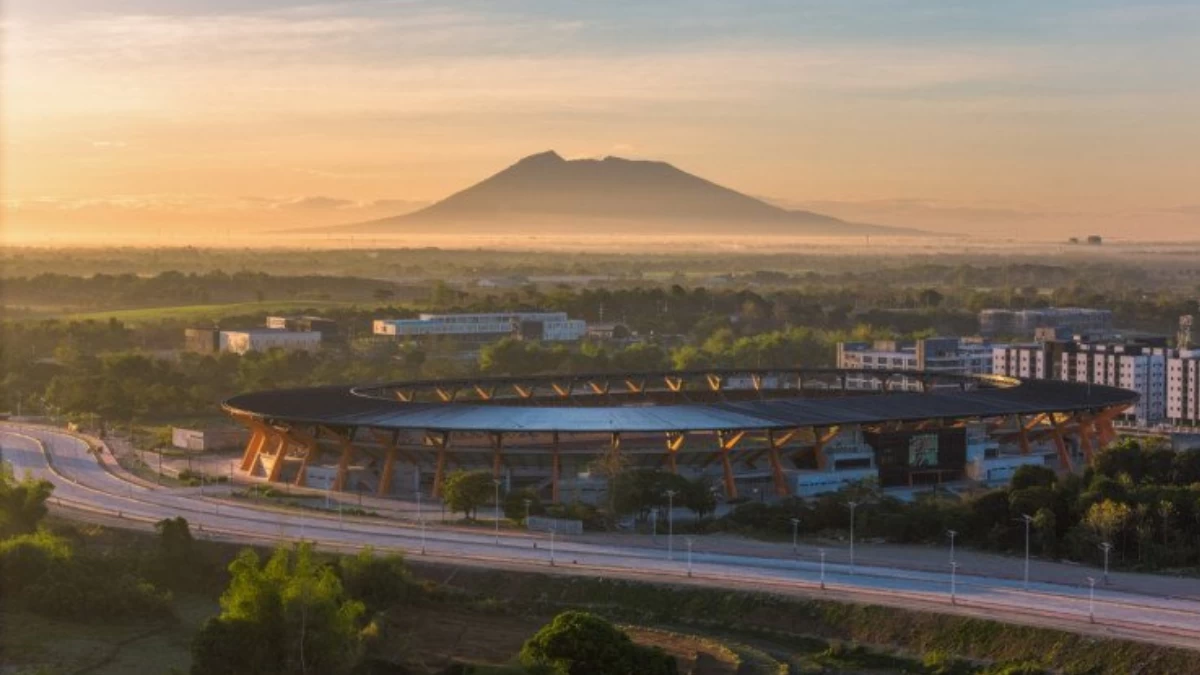
New Clark City (Photo: BCDA)
Washington picked New Clark City for the first Pax Silica hub, and no neighbor can say the same. But an invitation does not generate electricity or on-the-ground ready capability. While Vietnam, Malaysia and Indonesia have all shown interest in hosting a hub, only the Philippines and Singapore are the only Southeast Asian signatories. Manila is offering 1,620 hectares of government-titled land inside the 9,450-hectare New Clark City, with a first phase of roughly 500 hectares and construction starting in 2028.
Malaysia
Malaysia is the hardest comparison for Manila, mainly on cost. Its average electricity price is about $0.05 per kilowatt-hour. The Philippines charges $0.20, four times as expensive. Malaysia also handles roughly 13 percent of global chip packaging and testing, with established clusters in Penang and Kulim, and industrial land in Johor and the Klang Valley is plentiful.
The Philippine answer is the PEZA network. It counts 436 ecozones and 4,388 locators nationwide, and 219 ecozones with 1,748 registered enterprises along the Luzon Economic Corridor, among them Texas Instruments, Analog Devices, Amkor, and ON Semiconductor. Semiconductor exports hit $34.62 billion in 2025. However, most of that is assembly, testing, and packaging, the lower end of the chain.
Kuala Lumpur has stayed outside Pax Silica. Its trade deal with Washington commits it to align with US export controls and lets the United States terminate the agreement if Malaysia signs a deal with a country that jeopardizes American interests, with China being the obvious example. Malaysia has its own strain: Johor stopped approving the largest data centers over water supply concerns, and water tariffs in some hubs rose 30 percent to 50 percent.
Vietnam
Vietnam is building faster than the Philippines. Viettel broke ground in January on its first chip fabrication plant, a 27-hectare site with trial production targeted for the end of 2027. Chip-related foreign investment stands at $14.2 billion, and 166 universities teach semiconductor courses to some 134,000 students a year. The Philippine pipeline looks very thin beside that number. A recent study found trainings here is still aimed mostly at low- and medium-skilled jobs, while the national roadmap wants 128,000 semiconductor professionals within five years. A very tall order.
Electricity in Vietnam averages $0.08, 2.5 times cheaper than in the Philippines, though blackouts have recently hit Vietnam factories. Also, its dependence on China is much heavier. Imports from China reached $138 billion in the first seven months of 2026, and at one industrial developer the share of Chinese tenants went from about 20 percent in 2020 to over 40 percent. Washington reads that as transshipment risk. Vietnam has only a framework trade deal with the United States, at a 20 percent tariff, and no Pax Silica seat.
Indonesia
Indonesia has the minerals and the least chip experience. It has no fabrication and little chip design, although assembly and testing are growing around Batam. Power costs about $0.09 per kilowatt-hour, 2.2 times less than the Philippine price. Jakarta ratified a $38.4 billion trade pact with Washington in February.
China is the sticking point. Chinese investors have put more than $65 billion into Indonesian nickel and control about three-quarters of the industry, which makes a Western-aligned critical-minerals hub hard to build. On that score, the Philippines is the cleaner partner.
What the comparison shows
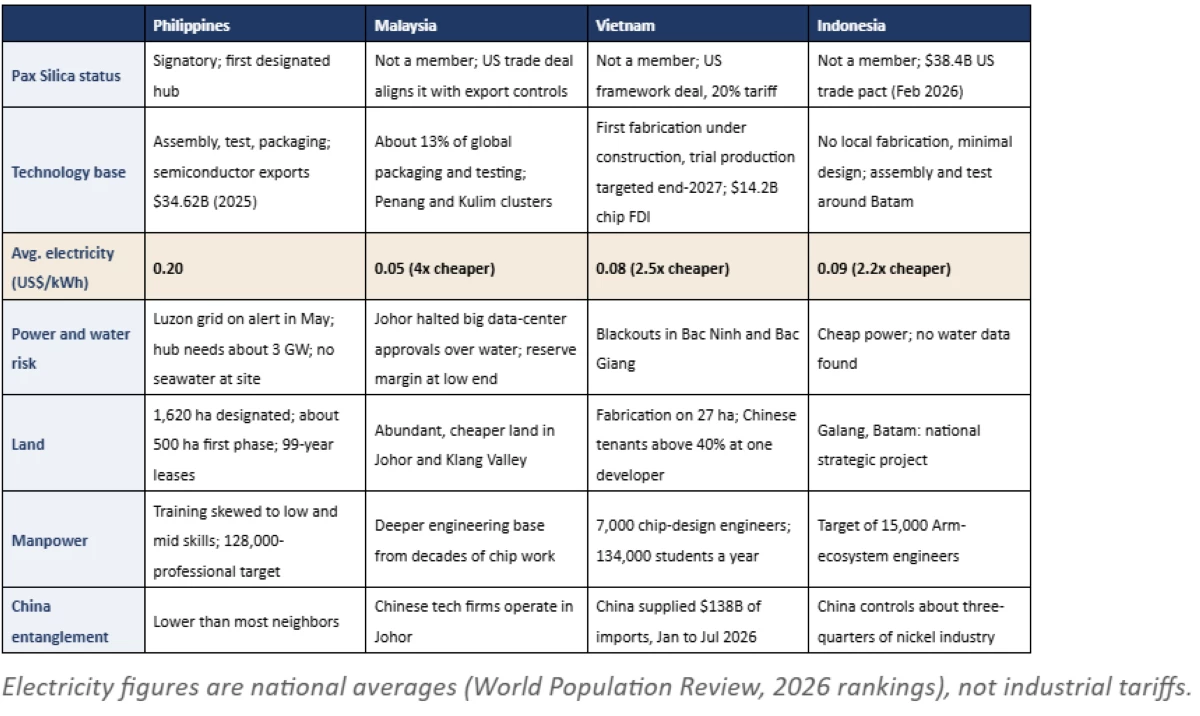
*Electricity figures are national averages (World Population Review, 2026 rankings), not industrial tariffs. (Image: Lobien)
The comparison helps because it puts numbers on gaps that still have time to close, since construction does not start until 2028. It also shows where the Philippines is genuinely ahead: political alignment, which rivals cannot copy quickly. Pax Silica is built around trust and advanced capability, so judging the Philippines by Malaysia’s assembly record sells it short, and Malaysia is not even a member. The fourfold power gap compares national averages, while the hub is meant to have its own supply, so its real cost is still unknown.
Conclusion
The Philippines leads in alignment. It is a US treaty ally and a signatory; analysts see it as less tied to Chinese capital than most of its neighbors, and its workforce is young at 26 years old. Land is the smallest problem, with 1,620 hectares set aside—which is very favorable for the Philippine real estate industry.
Delivery is the weak side. In May, the Luzon grid went under red and yellow alerts with 4,242.5 megawatts unavailable, and the hub is projected to need about three gigawatts at full build. The Department of Energy has warned that the load cannot simply plug into the grid. The developer’s answer is a 500-megawatt solar farm and a substation at Capas targeted at the end of 2028, again, another tall order. Further, New Clark City has no seawater to desalinate. Finally, foreign direct investment fell 4.0 percent in 2025, and the proposed 2027 budget has no line for the hub, suggesting confidence and financial support issues.
If utilities slip past 2028, Washington can place the next node in Malaysia or Vietnam, and the Philippines would be left with the announcement and little else. That outcome is avoidable. Clark Freeport already hosts 1,300 locators and more than 150,000 workers on 4,400 hectares, and PEZA had attracted ₱216.46 billion in investment by August. If power and water are secured first and engineers are trained in parallel, the hub has a workable base to grow from. This might be the most consequential real estate decision the country will ever have in this generation.
Source: Manila Bulletin